A closer likeness.
A young officer. A thoughtful correspondent. A face shaped by the surviving portraits of General James Wolfe.
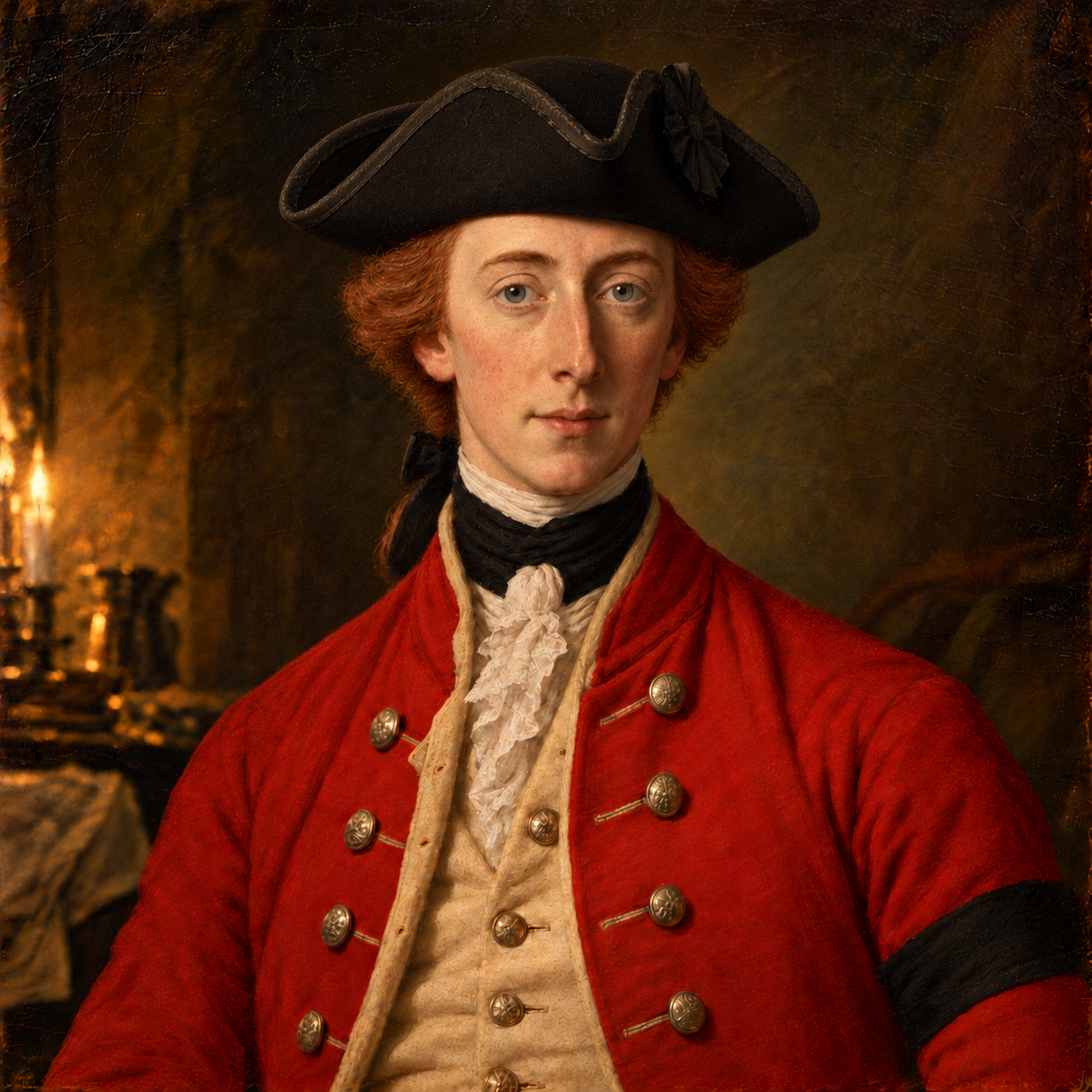
Looking past the legend.
Our principal visual guides are George Townshend’s 1759 watercolor and the profile attributed to Wolfe’s aide Hervey Smyth. The Ferguson miniature and the early Schaak portrait provide additional checks. Later heroic paintings carry less weight as evidence of the living man.
The result emphasizes reddish hair and a tied queue, blue-grey eyes, a prominent nose and smaller chin. His simpler scarlet coat and black neck stock follow the portrait evidence. The black cocked hat and rosette draw on the National Portrait Gallery’s Schaak portrait, a posthumous likeness. His eyes remain clear beneath the brim.
He now faces his company directly. The surviving profile and three-quarter views guide that frontal interpretation; they cannot establish an exact front view. The hand, wrist and sleeve have also been refined: the forearm rises closer to his body and the tankard stays steadier through the toast.
A little more of the man.
His family letters reveal affection, introspection and self-criticism, alongside an acknowledged quick temper. That suggested a thoughtful, attentive presence who can warm into the company around him. The animation now gives each passage its own expression, from a welcoming smile and dry amusement to quieter reflection, with a warm finish to the club toast.
The surviving images differ, and some attributions remain uncertain. We cannot recover his exact face, voice or habitual gestures. The Tavern’s dialogue and tankard toast are our own creative performances.
Portraits & correspondence.
- Townshend’s watercolor, 1759 · McCord M245 — our main reference for facial character and color.
- The Smyth profile · National Trust 528901 — traditionally a lifetime sketch, with an attribution that deserves care.
- Ferguson’s miniature, c.1750 · National Army Museum — an additional view of the younger Wolfe.
- Schaak after Smyth, 1760 · National Army Museum — an early posthumous portrait, not a sitting from life.
- Schaak portrait, c.1767 · National Portrait Gallery NPG 48 — the black tricorne hat and rosette, interpreted in our frontal pose.
- National Portrait Gallery’s portrait research — the differences between likenesses, copies and later inventions.
- Wolfe’s letters to his parents · Lawrence Ostola — an introduction to the private correspondence behind the public figure.
Research and portrait revised October 2026.